

Published August 31, 2026
BY JADE GRANBERY
Widely anticipated by literature lovers and film fanatics alike, Christopher Nolan’s “The Odyssey” delivers a stunning display of cinematic accomplishment, but disappointingly reworks a classic tale into an Americanized blockbuster.
From a technical standpoint, Nolan’s three-hour adaptation is quite the feat. Shot entirely on IMAX cameras, giant pieces of equipment that can only record up to three minutes at a time, “The Odyssey” demonstrates extraordinary use of massive sets, practical effects, real locations and animatronics to make the mythical world feel realistic. Mythic creatures like the 60-foot Cyclops, brought to life by a massive mechanical puppet, are more tangible than the CGI-heavy monsters common today. Nolan clearly had no interest in taking an easy route, something worth appreciating in an age where computers can make almost anything possible.
Unfortunately, that ambition doesn’t always extend to the script. For a story rooted in ancient epic, the dialogue sounds unmistakably American, with language and humor that feel more like a contemporary blockbuster than a Greek tale. That disconnect is only amplified by a cast of instantly recognizable faces. From Matt Damon to Zendaya, it’s difficult to forget you’re watching actors acting rather than characters inhabiting Homer’s world.
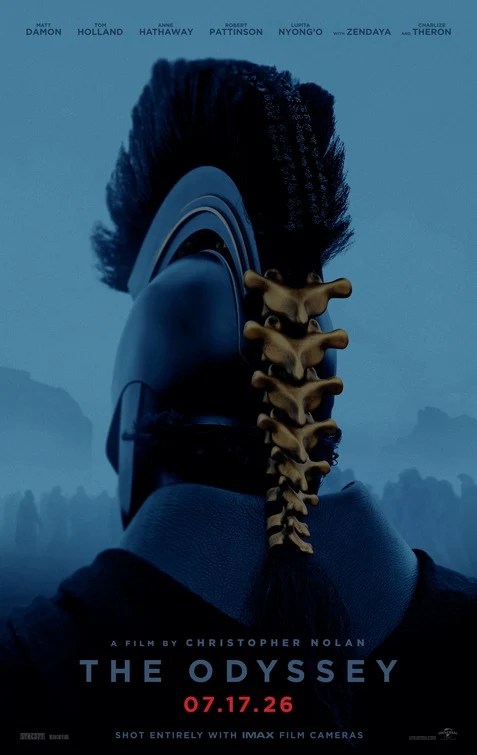
Christopher Nolan’s “The Odyssey” broke records at the box office, generating over $1.35 billion and becoming the highest grossing rated-R movie in history. courtesy of UNIVERSAL PICTURES
While changes are inevitable in book-to-movie adaptations, Nolan’s alterations feel unnecessary and, at times, detrimental to the plot. Most troubling changes are to characters themselves. Odysseus is still intelligent and determined, but Damon’s version is far more conflicted and guilt-ridden, at the expense of Homer’s cocky hero. Odysseus’ hubris—excessive pride, or, more classically, thinking you’re above the gods—is no minor trait. It drives the plot, accumulating his decisions and bringing their wrath upon him. Replacing much of that arrogance with typical war-movie trauma themes fundamentally changes the man at the center of the epic.
Several important episodes are also altered or omitted. While some changes, such as the transformation of the flesh-eating Laestygonians into giant warriors, make sense for the big screen, others strip away from the story. The notably absent ‘Nobody’ trick and Odysseus’ boastful revelation of his identity are crucial in understanding his genius and his fatal flaw: He’s clever enough to outsmart the monster, yet arrogant enough to spoil his own victory.
The omission of key plot points like Aeolus’ bag of winds and the Phaeacians leave out important steps in Odysseus’ iconic journey, making the retelling feel incomplete. The almost eradicated the roles of the gods help maintain the serious, realistic atmosphere, but drain the original myth.
While a creative approach is sometimes a good way to rework something as old and well known as “The Odyssey,” Nolan’s creative choices don’t demonstrate an attempt to artistically represent the ancient tale, but rather to reshape it into a story that fits his own filmmaking style. The result is a movie that is undeniably impressive but increasingly difficult to recognize as the epic, and unfortunately, likely will be how many people today will now perceive Homer’s work.
7/10


